Most AI app builders can do the same trick now. You type a sentence, and a working screen appears. That makes them hard to compare. Searching for the best AI app builder does not help, because most ranked lists score that same first prompt.
It used to be simpler: you lined up one drag-and-drop app builder against the next and picked the best app builder on features.
The first prompt is not the hard part. The next month is. That is when you have to put the app somewhere real, store your business data, pass a security review, and get it to the people who need it.
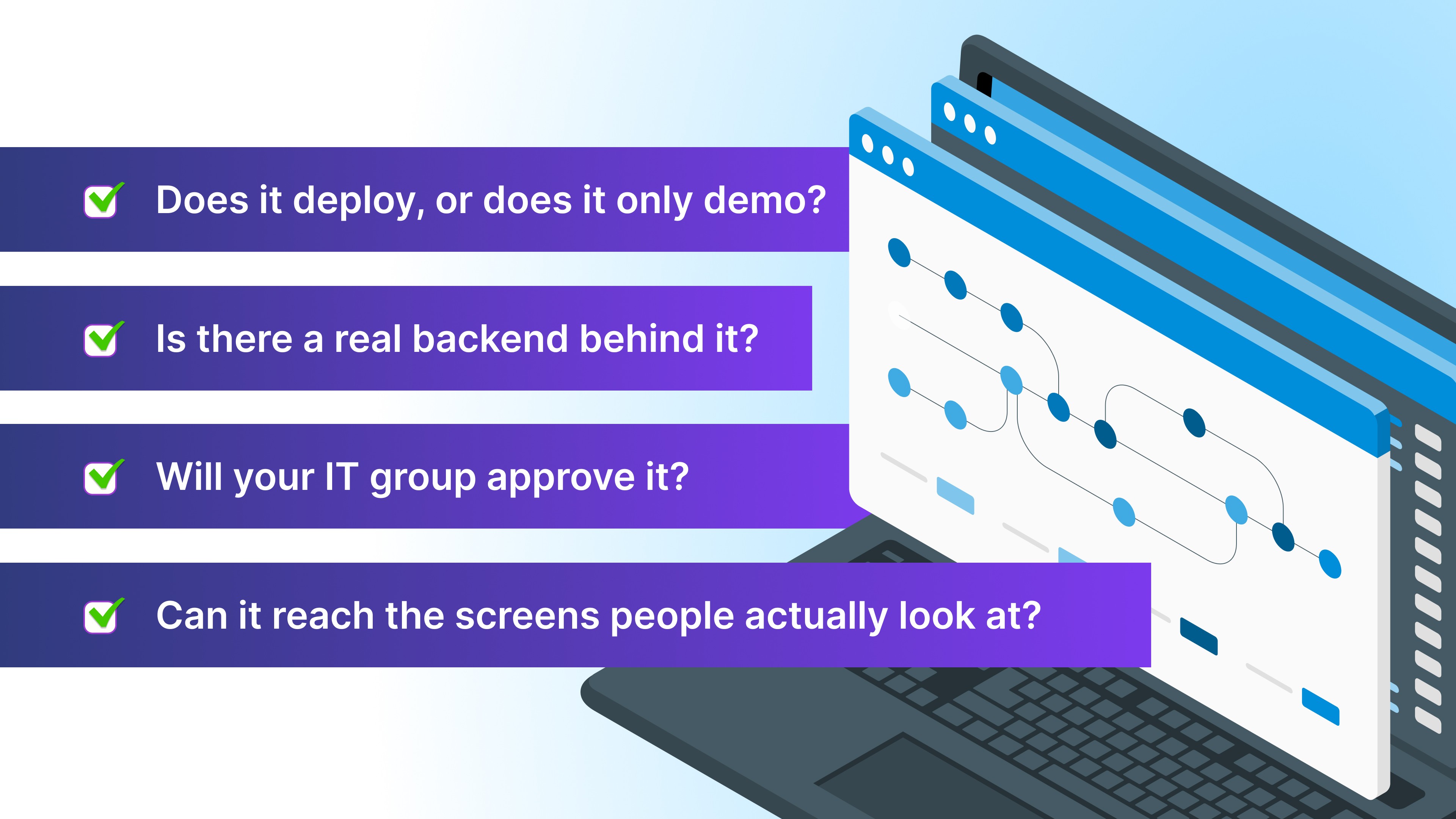
So here are four questions instead of a ranking:
Does it deploy, or does it only demo?
Is there a real backend behind it?
Will your IT group approve it?
Can it reach the screens people actually look at?
Each comes with a test you can run today on any builder's free tier, OptiDev's included.
Does it deploy, or does it only demo?
A builder that generates a working frontend and hands back a preview link or a repository has done exactly what it said it would. Most app builder software stops there. That is not the same as having an app your team can open on Monday.
Build the smallest thing you can think of, then send it to one colleague who has no account on the builder. If the only way they can see it is a link that dies with your session, or if the next step is you finding somewhere to host it, the tool demos rather than deploys, and the hosting conversation you thought you had escaped arrives three weeks in.
Check two more things: a domain your business already owns and a certificate you did not have to arrange. This is the gap Why Most AI Generated Apps Never Reach Production is about.
With OptiDev, publishing puts the app on a live URL, and a domain you own can point at it with the certificate handled.
Is there a real backend behind it?
Generating a screen and running a business application are different problems. The screen is the part AI is spectacular at. The part that has to still be true tomorrow is a database, a way of knowing who is allowed in, somewhere for files to go, and somewhere to keep a key that must not sit in a browser.
Ask the builder for an app that has to remember something from one visit to the next. One person fills in a form on Monday. A different person reads it on Wednesday, then refreshes the page. If the data is gone, or the tool hands you instructions for setting up a database somewhere else, you are buying a frontend generator, and you will buy the backend separately, which is how a tool your ops team can use becomes a project your engineers own.
What you want is a database app builder, not a screen generator. Ask for four things by name: a database, authentication, file storage, and somewhere server-side to run code that holds a key.
With OptiDev, a managed Postgres database, authentication, file storage, and server-side functions come with the app rather than being assembled around it.
Will your IT group approve it?
Most people reading this are not the person who runs the security review. They are the person whose project dies quietly two weeks after they forward the tool to someone who does. So the test is not whether it is secure. It is whether you can answer four questions without booking a call.
Go looking for the security documentation before you go looking for the demo. If the four answers are not written down on a page you can forward to somebody, that is your answer, and it is the answer your IT group will give you, arriving not as a rejection but as a project that stops being mentioned.
Forward these four. Where the business data physically lives. Whether single sign-on exists on a plan you would actually buy. What happens to an API key you paste in? Whether the AI itself can read your data or another customer’s.
OptiDev publishes its answers, and How OptiDev Secures Every App You Build walks through them.
Can it reach the screens people actually look at?
Most builders assume the finished app gets opened in a browser tab by somebody who chose to open it. If that is you, skip this one.
When it is not, the app is a board on a production wall, a lobby directory, a check in screen at a door. Nobody logs in to those. They have to be on, on the right screen, showing the right thing.
Name the surface out loud before you evaluate anything. If the answer is a screen and not a tab, “it gives me a URL” is not a pass, because somebody still owns the box behind that screen and what happens when it reboots at 4am. In a small business that somebody is you.
With OptiDev there is a supported path from a built app to screens managed on OptiSigns, as the boards in How Manufacturers Are Tracking Production in Real Time do.
Frequently asked questions
What is the best AI app builder?
There is no single best AI app builder. The ranking flips depending on which of the four questions above binds for your business. If other people must open it, judge deployment. If it must remember anything, judge the backend. If IT has to sign off, judge the documentation. If it lives on a wall screen, judge reach. Most lists of the best app builders rank the first prompt instead.
What is the best no-code app builder?
The phrase describes tools built around assembling screens by hand. The best no code app builder for your business is still whichever clears the four questions above. AI builders meet the same need by writing the app instead. Compare across both on the same four tests.
Is an AI app builder the same as a website builder?
Not exactly. A website builder is usually built for marketing sites and public pages. An AI app builder is meant to create something with a database behind it, which is what a business application needs. And if it has to ship to an app store, that is a third category again.
Run your test
Take whichever tool you are already trying and run the test today, then run them on ours. You can build the first version free, no credit card required, and the prompt library beats a blank page.
Still deciding whether to use one at all? Start with vibe coding. If the real question is budget, that is The Real Cost of a Custom Internal Tool in 2026.
A tool that clears all four on a throwaway app has passed the right first test for the real one.