Someone on your team asked what it would cost to build the thing they have been doing by hand. A quote came back, large enough that the conversation ended there, and the team went back to the spreadsheet they had before.
The actual cost of the quote is the outcome, not the invoice.
Here is the strange part: the quote was probably fair, and custom software development cost is not one number. Building software to order is expensive, often for good reasons, but the figure on the quote is not the one that decides anything. Most of what the tool costs never appears on it. And there is a fourth option most comparisons leave out, where the person on the business side (who wanted the tool) describes it and has a working version the same day.
What custom software actually costs in 2026
How much does custom software development cost? For a small internal business tool, published 2026 estimates run from roughly $15,000 to $100,000. One 2026 pricing guide based on verified client reviews puts the average custom software project at $132,480, with a typical delivery time of about 13 months. Integrations and user counts move that price far more than features do.
Treat any single figure carefully. Published estimates vary widely, with internal business tools ranging from tens of thousands of dollars to several hundred thousand depending on scope, integrations, and who is estimating. The useful question is not “what does software cost?” but “what cost structure are you choosing?”
These are not four prices for the same thing. These are four different cost structures.
Path | Up front | Every year after | First version | When it is right |
|---|---|---|---|---|
An agency or dev shop | $15,000 to $100,000, fixed bid or time and materials | A retainer, commonly 15 to 25 percent of build cost | 2 to 4 months for a simple build, not the 13 month average above | Revenue critical, and the scope is knowable |
A developer, hired or contracted | $90 to $150 an hour, US contract | Ongoing developer time for fixes, updates and future changes | Weeks, once you find the person | Several tools to build, enough work to keep someone busy |
Your own IT team | No invoice, which is why this one gets mispriced | The queue. Every tool competes with the roadmap | However long the queue is | It touches systems only they can safely touch |
Describe it and have it built | Free to start. Paid plans from $25 a month | The same subscription, plus your time on changes | A working first version, same day | Scope will change as you use it, and whoever wants it can describe it |
Those rates are for US contract work; global averages run lower, and enterprise app development cost is a different class again.
What moves the price: how many business systems it talks to, how many people use it, whether it holds data worth protecting, and how much the workflow will change after launch. Most of that is coordination and risk rather than typing code, and that is the part that changed.
The costs that are not on the quote
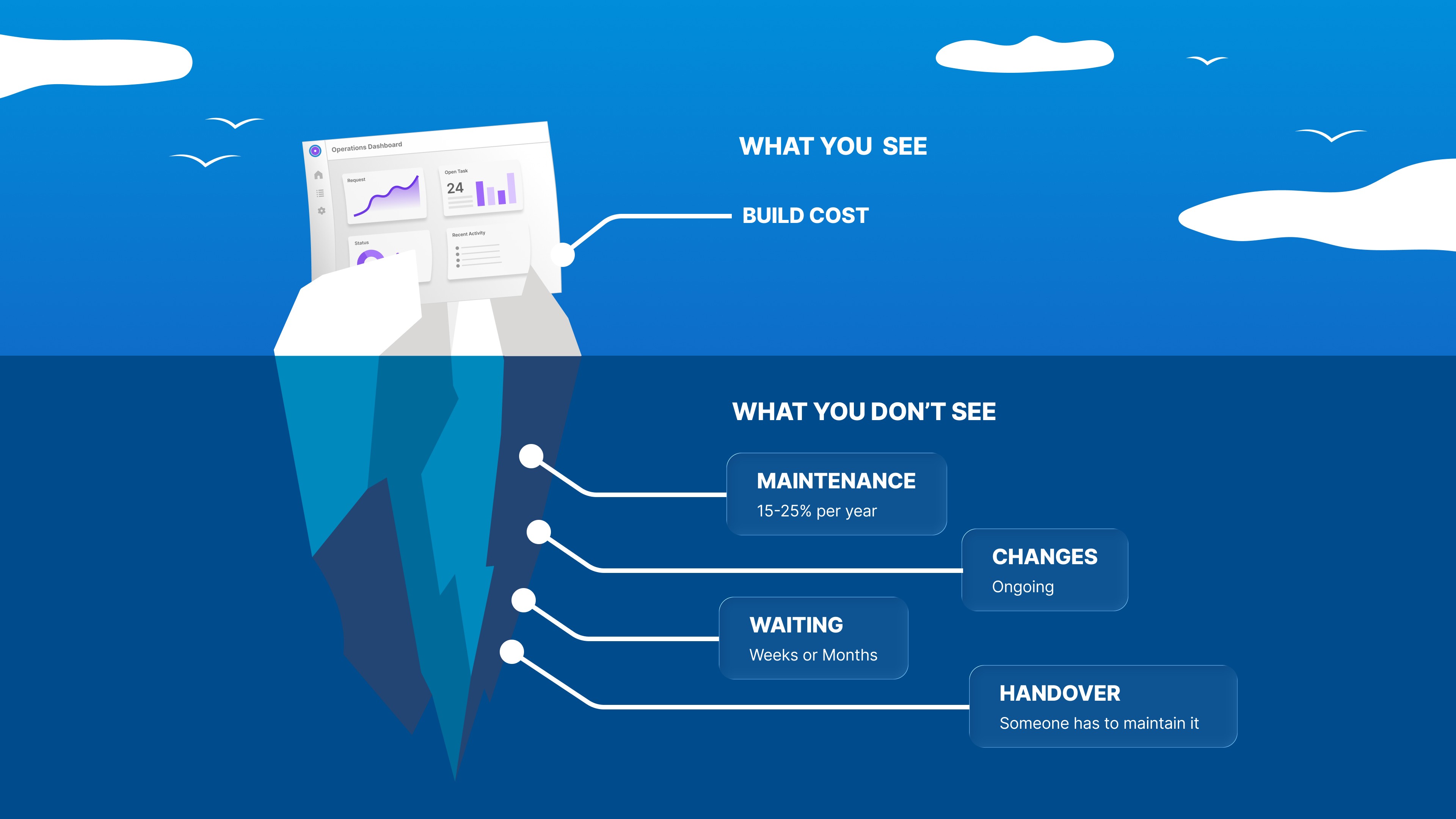
A quote prices the building, not any of this.
Maintenance, which is not optional. A foundational software maintenance study based on 487 organizations found that most post-launch effort goes to new and changed requirements, not bug fixes. That matters because internal tools rarely stay still. Budgets commonly assume 15 to 25 percent of build cost per year.
Change requests, which are the real shape of an internal tool. After two weeks of using the tool, you discover what you actually need, but under a fixed bid, every change has to be scoped, priced, and scheduled. It is how a tool ends up built precisely to a specification written before anyone had touched it, then quietly abandoned.
The waiting. Between the quote and the working tool, the manual process continues at its own cost every week. Almost nobody counts that.
The handover. Agency or employee, whoever built it moves on. Someone has to change it in year three.
Maintenance, change requests, and waiting are the same cost in different clothes: the distance between the person who wants the tool and the person who builds it.
The fourth option most cost comparisons leave out
What does AI app development cost for a business tool? OptiDev starts free with no credit card required, and paid plans begin at $25 per month. That covers the build, database, hosting and deployment, which on an agency quote are separate lines. It does not cover work that needs an engineer.
You describe the tool in plain language and get a working version back, then correct it by describing the correction: that number is buried, drop the second chart. The first version is wrong in small ways, and that is the point rather than the caveat. Nothing here is a change request, because there is no specification and nobody to hand it to.
This does not replace hiring a professional, and it is worth being exact about when it does not. If the tool is what your customers pay for, hire someone. If it has to clear a regulatory bar that a named person signs off on, hire someone. If it reaches deep into systems only your engineers can safely touch, that is their work. What is left after those exclusions is a large share of internal business software.
Backend, database, and access control come with the app rather than as separate lines, which How OptiDev Secures Every App You Build — From Day One covers.
How to tell which one your tool is
Two questions, answerable in a minute.
Could you write down everything it needs to do and be right? If yes, a fixed bid is safe. If no (for internal tools it usually is a no), then paying per specified change is the wrong structure, however good the rate looks.
Who is going to change it in six months? With no answer to that, the cheapest build becomes the most expensive tool you own.
Then a shortcut that beats all three. Build the first version yourself, use it for two weeks, then decide whether it needs a professional. Two weeks of real use tells you more about the scope than any specification round, and it costs the business almost nothing to find out.
Start with your version
You can build the first version free, no credit card required, and find out what your team actually asks for once it exists. The prompt library is a faster start than a blank page.
If it needs to become more than a demo, Why Most AI-Generated Apps Never Reach Production covers that next step. If the answer is still to hire someone, you will at least be hiring them for the right tool.